Helpling provides a platform for customers to find and book household service providers. The biggest drop is in the booking funnel, at the stage of provider selection.
Business problem:
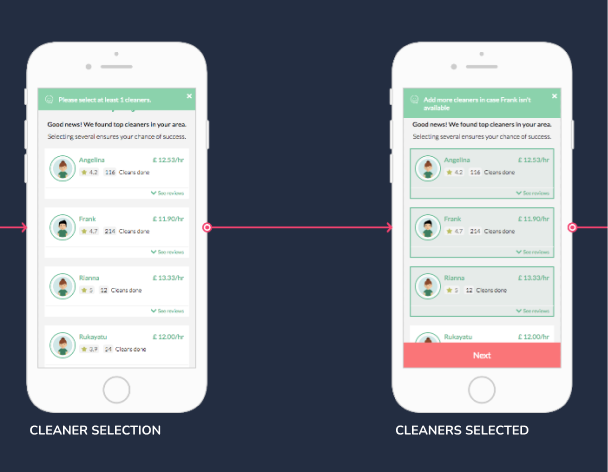
Most customers drop from the booking funnel during provider selection (see screens on image to the right).
Customer problem:
Customers are overwhelmed by the task of deciding a provider.
Customers want to select one provider, but don’t realize that selecting more will increase their chance of receiving one of the selected cleaner.
Additional Information:
Customers who select 1 provider have a 20% chance of receiving the selected provider, whereas customers who select 4 providers have an 80% chance of receiving the selected provider.
PROBLEM
Helpling provides a platform for customers to find and book household service providers. The biggest drop is in the booking funnel, at the stage of provider selection.
Business problem:
Most customers drop from the booking funnel during provider selection (see screens on image to the right).
Customer problem:
Customers are overwhelmed by the task of deciding a provider.
Customers want to select one provider, but don’t realize that selecting more will increase their chance of receiving one of the selected cleaner.
Additional Information:
Customers who select 1 provider have a 20% chance of receiving the selected provider, whereas customers who select 4 providers have an 80% chance of receiving the selected provider.
GOAL
Increase the number of customers making a booking by preventing the users to be overwhelmed and help users understand that the number of providers selected ensures them to receive who they choose.
GOAL
Increase the number of customers making a booking by preventing the users to be overwhelmed and help users understand that the number of providers selected ensures them to receive who they choose.
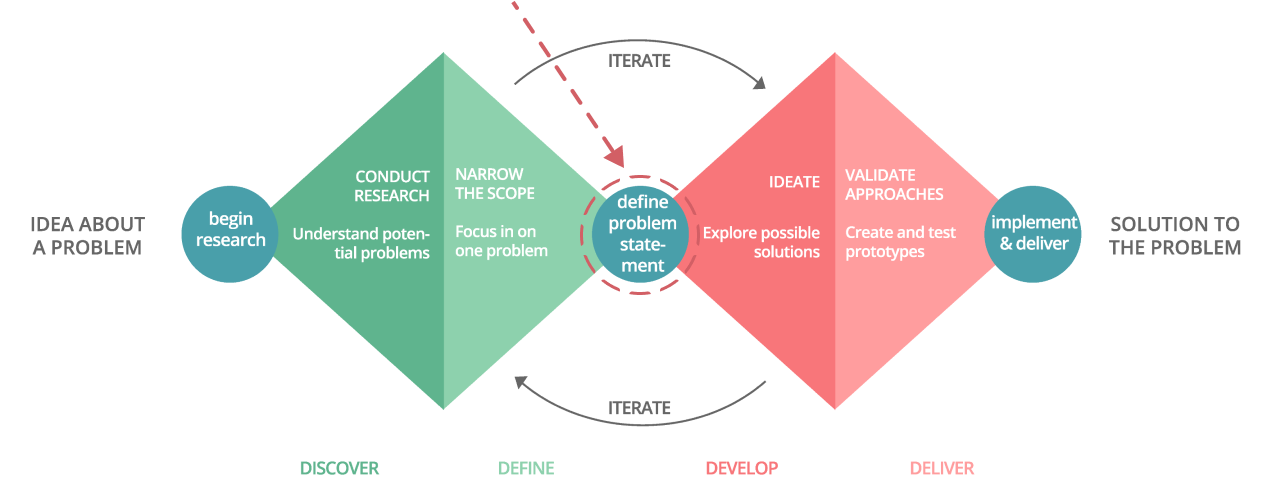
To solve the business and customer problems, I focused on the Double Diamond technique. This holistic tool helped me concentrate on breaking down the problems to develop better solutions. The Double Diamond is designed to not just help generate innovative ideas but put these activities in their proper chronological place. This made sure I was never retracing my steps, throwing away good ideas, or losing focus. As Helpling already narrowed the scope of the problem, I could jump right into defining the problem statement which is the center of this method.
METHOD USED
To solve the business and customer problems, I focused on the Double Diamond technique. This holistic tool helped me concentrate on breaking down the problems to develop better solutions. The Double Diamond is designed to not just help generate innovative ideas, but put these activities in their proper chronological place. This made sure I was never retracing my steps, throwing away good ideas, or losing focus. As Helpling already narrowed the scope of the problem, I could jump right into defining the problem statement, which is the center of this method.
THE FOUR Ws
In order to find solutions, I took the main problem, broke it down into the 4Ws.
WHY does the problem occur? Users are overwhelmed with the task of selecting providers and are not aware that they need to book more cleaners in order to get one they selected.
WHO is affected by the problem? People using the Helpling platform that are trying to book a service provider. Helpling is of course also affected as they are loosing potential bookings.
WHAT is the problem? Customers drop out of the booking funnel.
WHEN does this problem occur? During the provider selection.
THE FOUR Ws
In order to find solutions, I took the main problem, broke it down into the 4Ws.
WHY does the problem occur? Users are overwhelmed with the task of selecting providers and are not aware that they need to book more cleaners in order to get one they selected.
WHO is affected by the problem? People using the Helpling platform that are trying to book a service provider. Helpling is of course also affected as they are loosing potential bookings.
WHAT is the problem? Customers drop out of the booking funnel.
WHEN does this problem occur?
During the provider selection.
PROBLEM STATEMENTS & ASK WHY
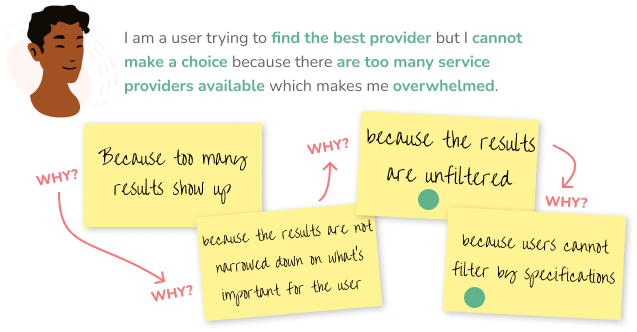
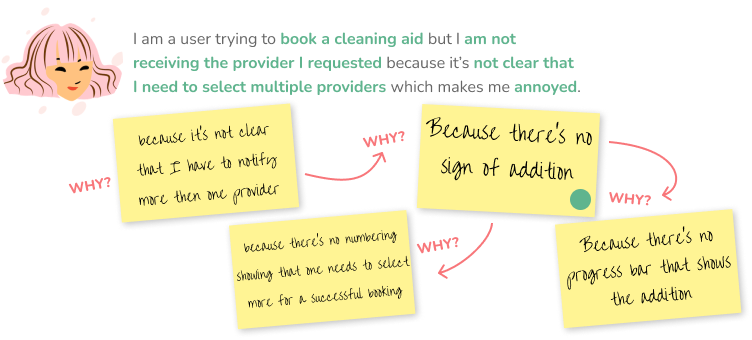
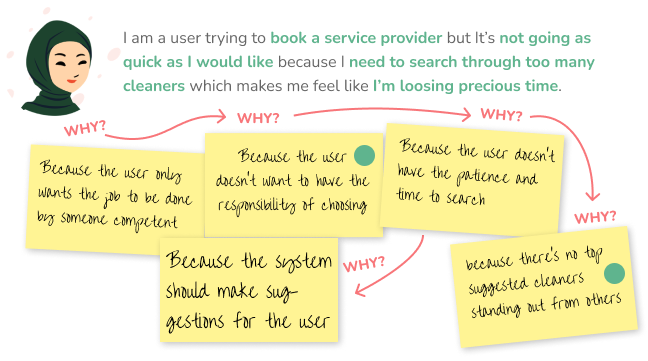
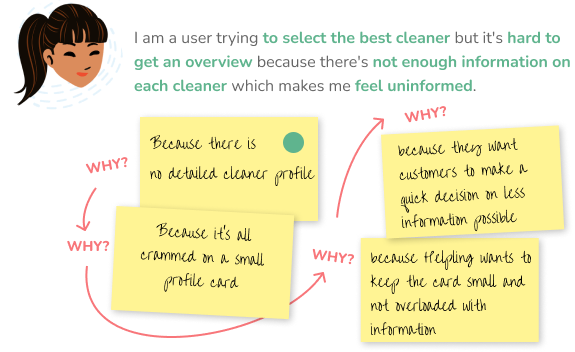
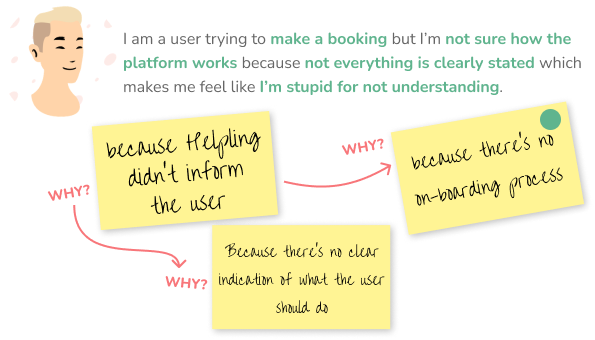
I then created a few problem statements from a user’s point of view with my own assumptions. Below, you will find the most valuable ones. From there, I asked many times why, to get to the bottom of the problems. “Why” is one of the most powerful questions one can ask and it gives me the possibility to get 1 step closer to finding solutions to the problem statements.
PROBLEM STATEMENTS & ASK WHY
I then created a few problem statements from a user’s point of view with my own assumptions. Below, you will find the most valuable ones. From there, I asked many times why, to get to the bottom of the problems. “Why” is one of the most powerful questions one can ask and it gives me the possibility to get 1 step closer to finding solutions to the problem statements.
COMPETITIVE ANALYSIS & HMW
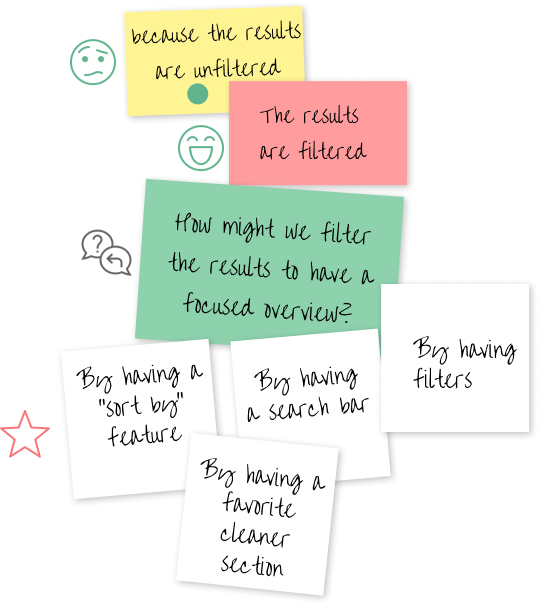
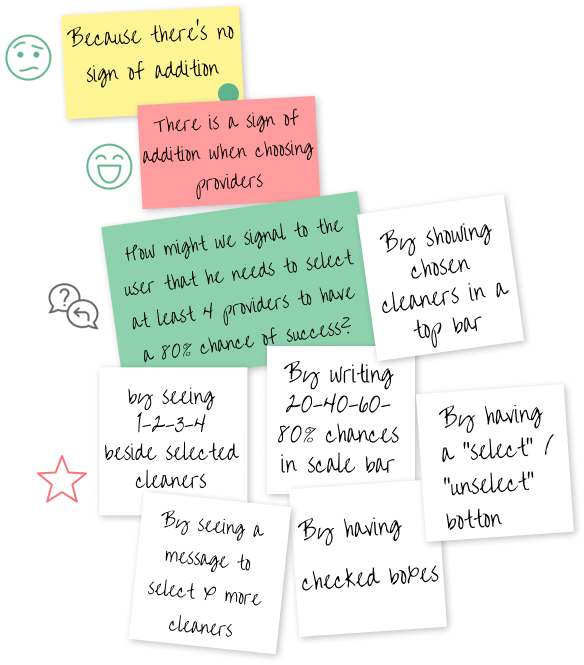
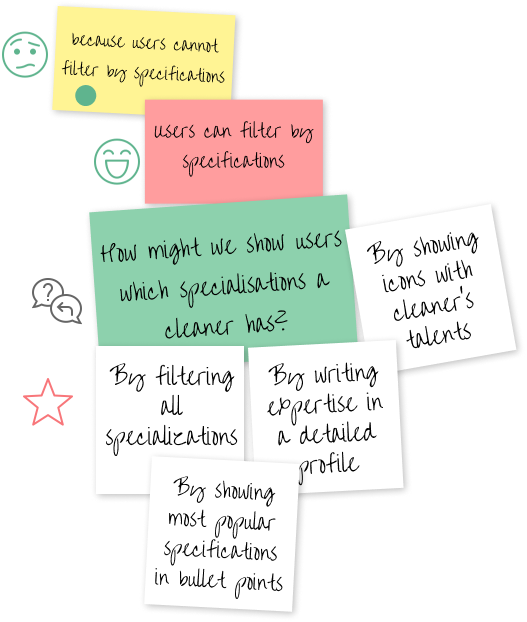
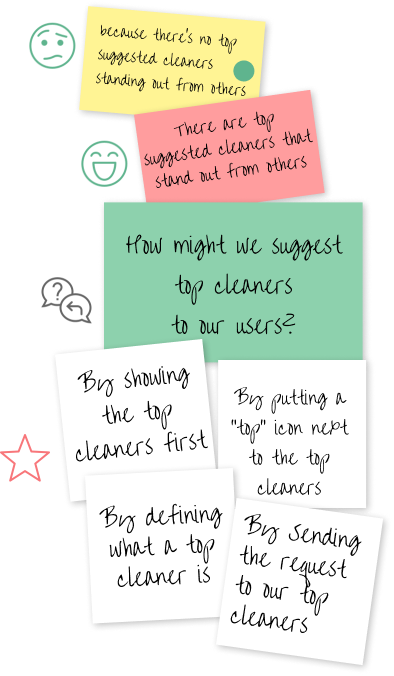
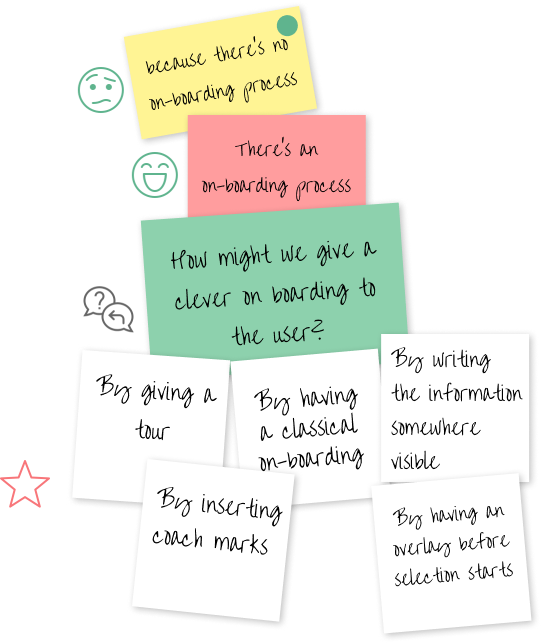
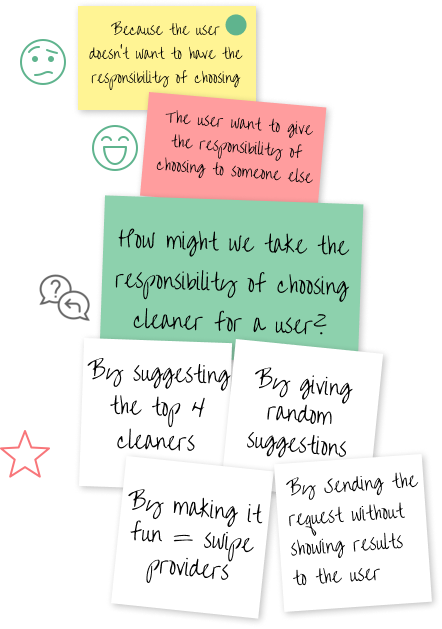
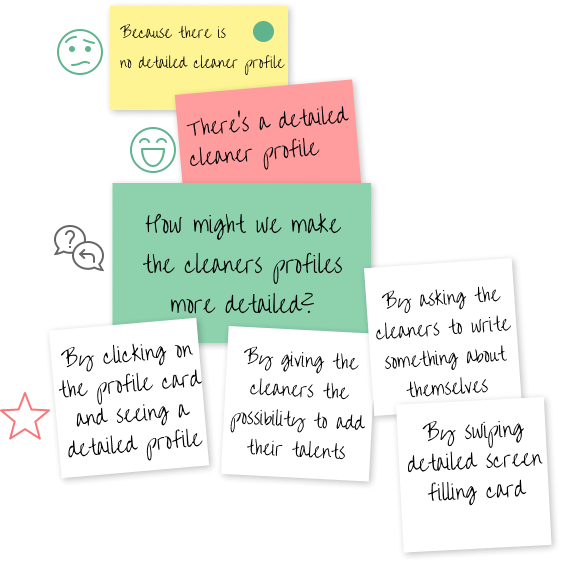
After conducting a competitive analysis and getting inspired for future features, I took the most relevant “why post-its” which are negative and switched them into positive sentences (pink post-its). Then I transformed them into “How Might We” statements (green post-its). This exercise is the best way to open up Brainstorm and allows me to see opportunities in the challenges. HMW opens up to Ideation sessions where I can explore ideas that can help me solve the design question. From there, I brainstormed more, this time some features (white post-its) that could answer the HMW questions.
COMPETITIVE ANALYSIS & HMW
After conducting a competitive analysis and getting inspired for future features, I took the most relevant “why post-its” which are negative and switched them into positive sentences (pink post-its). Then I transformed them into “How Might We” statements (green post-its). This exercise is the best way to open up Brainstorm and allows me to see opportunities in the challenges. HMW opens up to Ideation sessions where I can explore ideas that can help me solve the design question. From there, I brainstormed more, this time some features (white post-its) that could answer the HMW questions.
CREATING USER NEED STATEMENTS
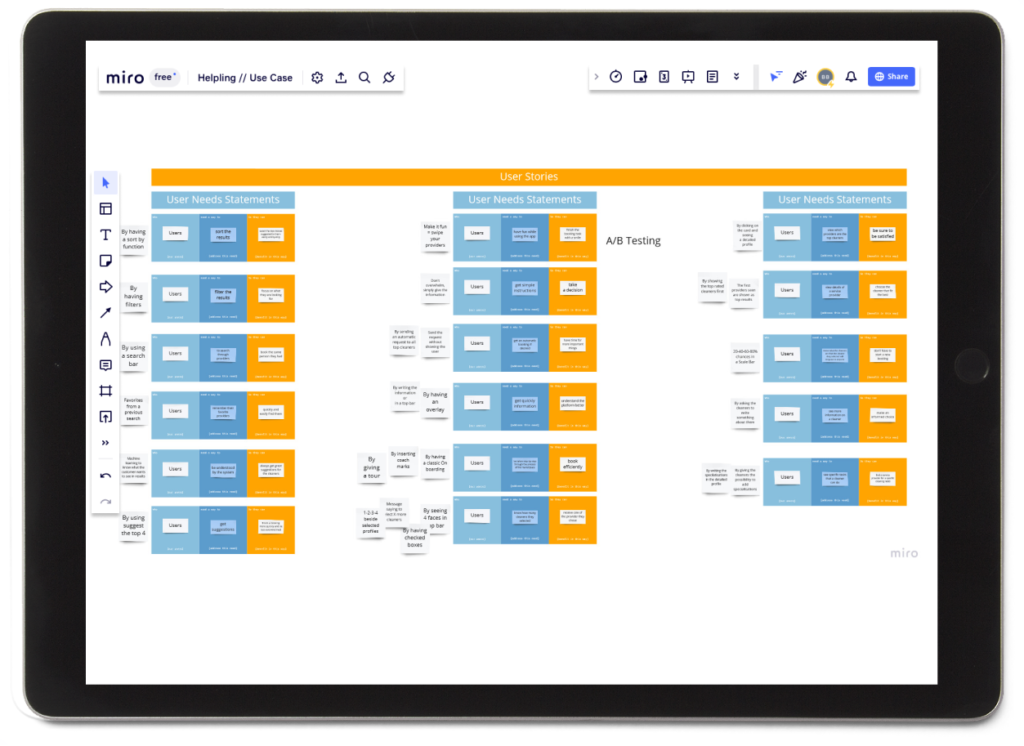
Users have many needs, so I made a list of user stories / user needs statements. User stories are short, simple, and informal descriptions of software features from the end user’s perspective. They help articulate what value a product feature can bring and have a better understanding of why users want a certain functionality. Therefore, I took each feature ideas from the previous exercises and created user need statements to validate my hypotheses. Here are a few examples:
Users need a way to filter the results so they can focus on what they are looking for.
Users need a way to view details of a service provider so they can choose the cleaner that fit the best.
Users need a way to get suggestions so they can finish a booking more quickly and be less overwhelmed.
Users need a way to know how many cleaners they selected so they can receive one of the provider they chose.
CREATING USER NEED STATEMENTS
Users have many needs, so I made a list of user stories / user needs statements. User stories are short, simple, and informal descriptions of software features from the end user’s perspective. They help articulate what value a product feature can bring and have a better understanding of why users want a certain functionality. Therefore, I took each feature ideas from the previous exercises and created user need statements to validate my hypotheses. Here are a few examples:
Users need a way to filter the results so they can focus on what they are looking for.
Users need a way to view details of a service provider so they can choose the cleaner that fit the best.
Users need a way to get suggestions so they can finish a booking more quickly and be less overwhelmed.
Users need a way to know how many cleaners they selected so they can receive one of the provider they chose.
PRIORITIZING USER NEEDS STATEMENTS
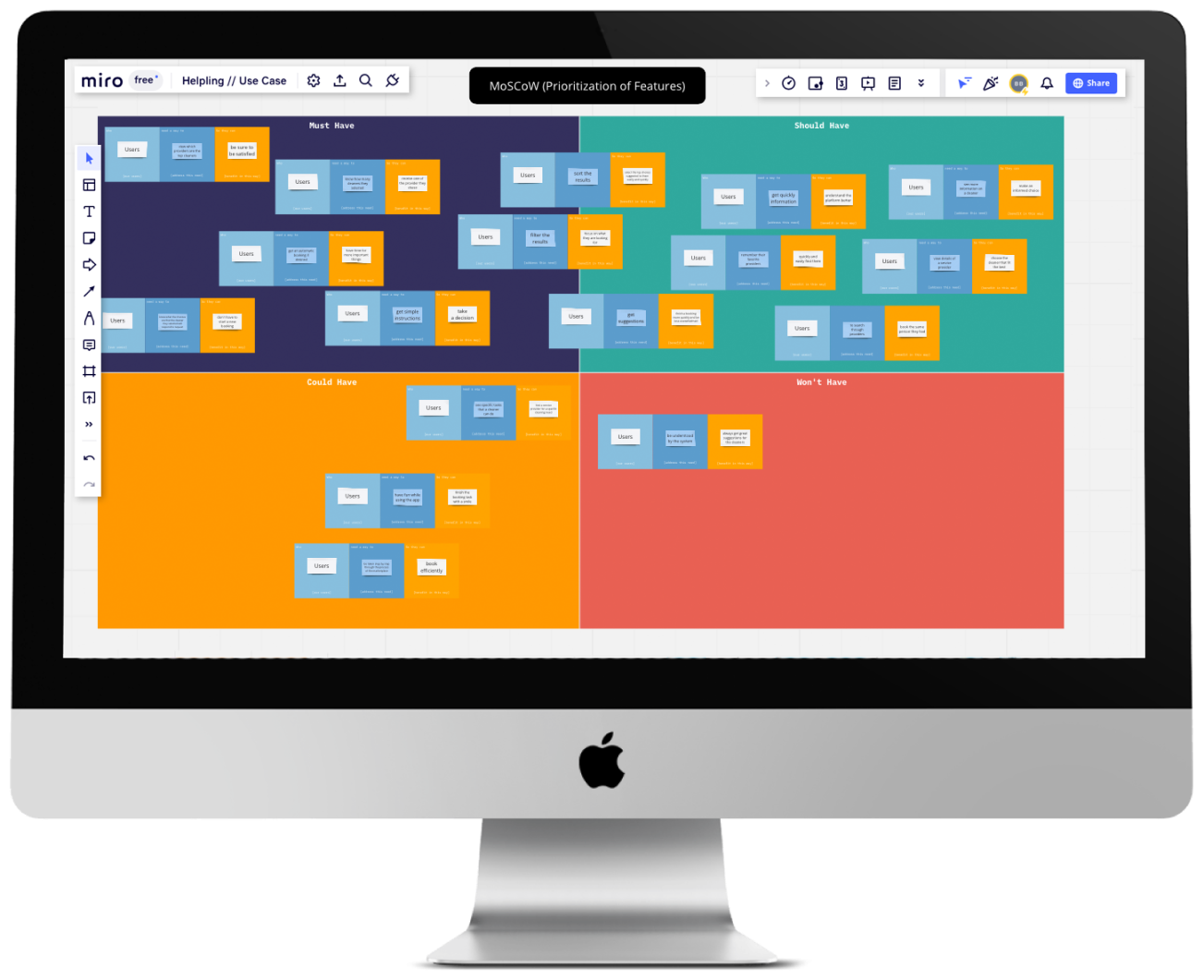
Prioritizing the user need statements with the MoSCoW method was the next step. On the below matrix, I placed all user need statements in the different sections: Must Have (top left) – Should Have (top right)- Could Have (bottom left) and Won’t Have (bottom right). This was important in order to see which features I would sketch, wire frame and implement into my prototype.
Here you can see which I prioritized as “Must Haves” because they are the most vital for the solution to the problem:
Users need a way to view which providers are the top cleaners so they can be less overwhelmed.
Users need a way to get an automatic booking if desired so they can have more time for important things.
Users need a way to get simple instructions so they can take a decision.
Users need a way to know what the chances are that they receive one of the selected cleaners so they can not be disappointed.
Users need a way to know how many cleaners they selected so they can receive one of the provider they chose.
Users need a way to filter the results so they can focus on what they are looking for.
PRIORITIZING USER NEEDS STATEMENTS
Prioritizing the user need statements with the MoSCoW method was the next step. On the below matrix, I placed all user need statements in the different sections: Must Have (top left) – Should Have (top right)- Could Have (bottom left) and Won’t Have (bottom right). This was important in order to see which features I would sketch, wire frame and implement into my prototype.
Here you can see which I prioritized as “Must Haves” because they are the most vital for the solution to the problem:
Users need a way to view which providers are the top cleaners so they can be less overwhelmed.
Users need a way to get an automatic booking if desired so they can have more time for important things.
Users need a way to get simple instructions so they can take a decision.
Users need a way to know what the chances are that they receive one of the selected cleaners so they can not be disappointed.
Users need a way to know how many cleaners they selected so they can receive one of the provider they chose.
Users need a way to filter the results so they can focus on what they are looking for.
SKETCHING UP SOLUTIONS
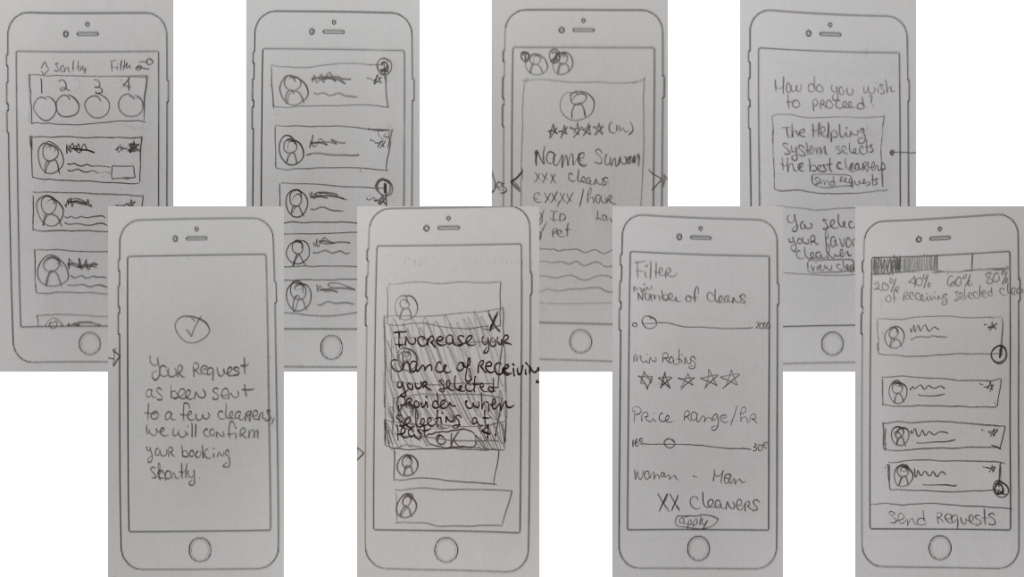
Sketching my ideas in wireframes gather my ideas and functional requirements together and help me see the full picture. I took all the Must-Haves user need statements and sketched, with pen and paper, a few screens.
SKETCHING UP SOLUTIONS
Sketching my ideas in wireframes gather my ideas and functional requirements together and help me see the full picture. I took all the Must-Haves user need statements and sketched, with pen and paper, a few screens.
RAPID PROTOTYPING
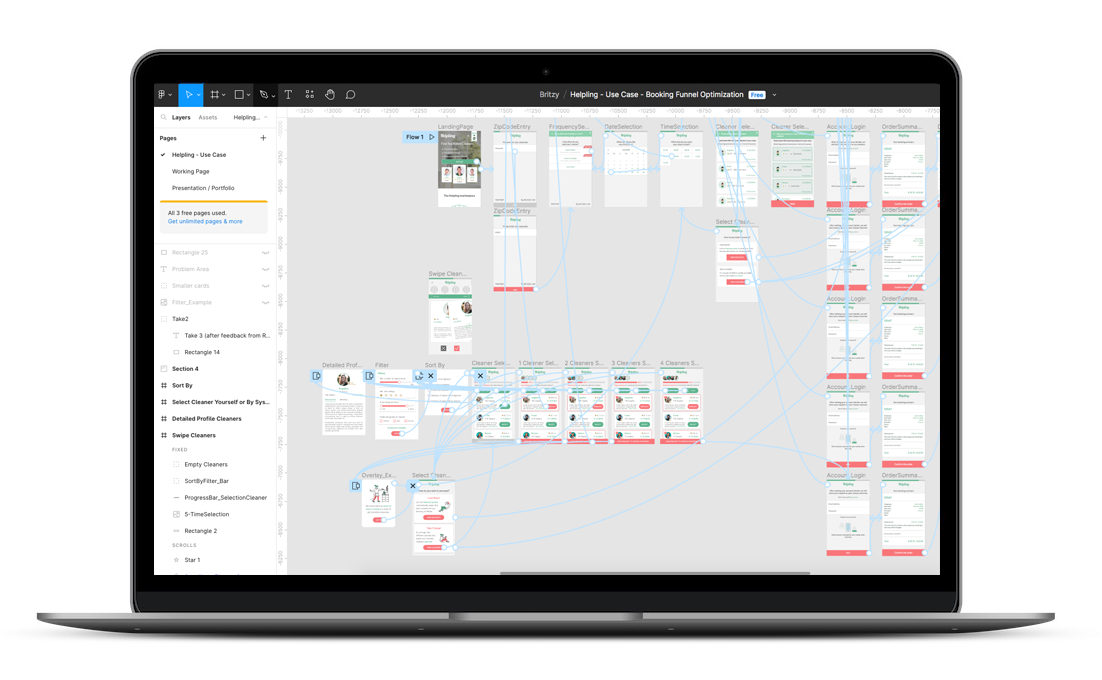
After sketching, I created the new screens of the problem area and made a clickable prototype.
RAPID PROTOTYPING
After sketching, I created the new screens of the problem area and made a clickable prototype.
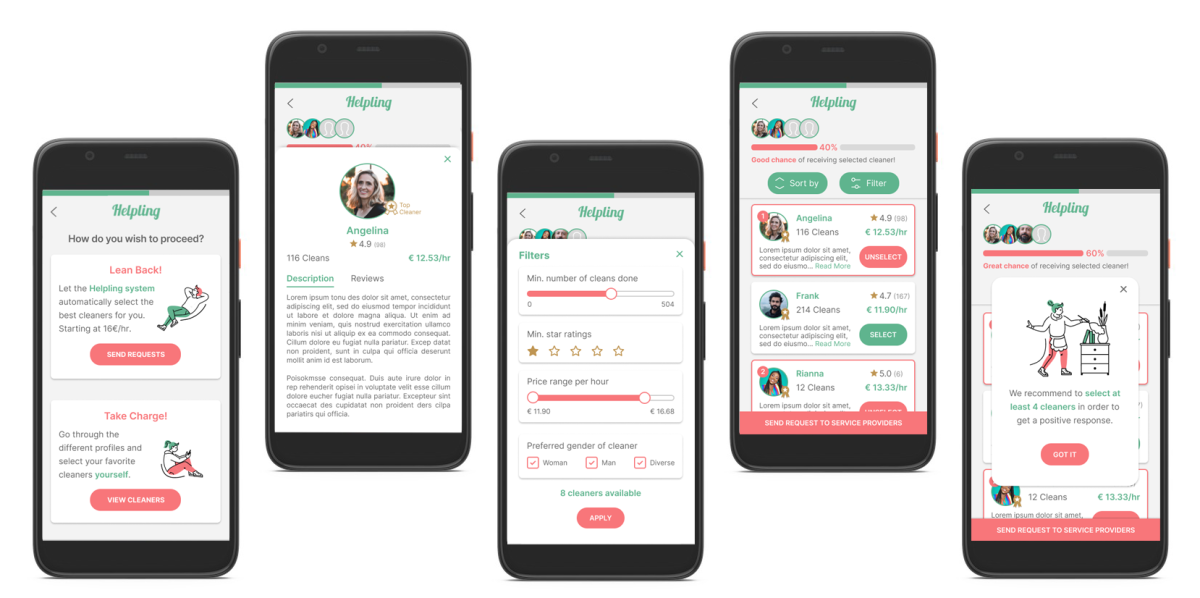
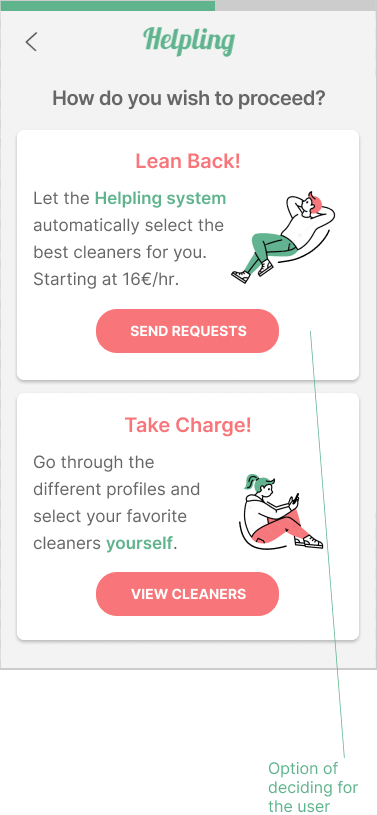
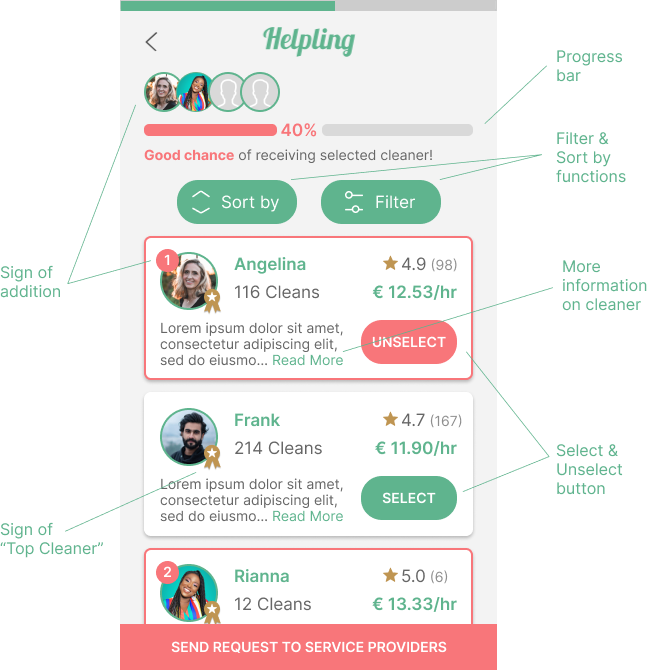
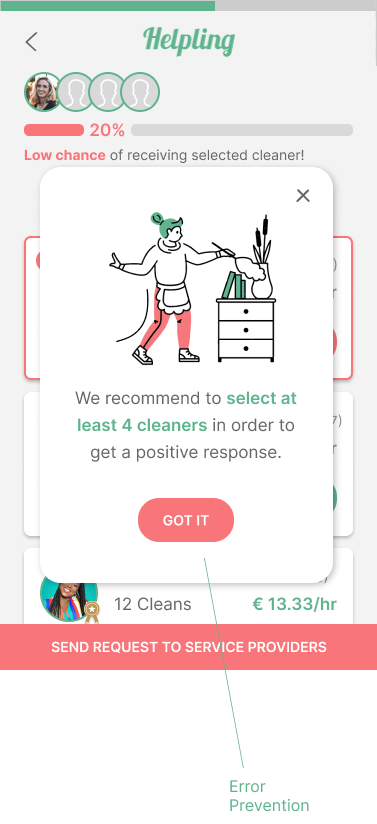
Here are some clear improvements to the UI & UX of the booking funnel of the Helpling app which were crystallized through my above process.
IMPROVED CHANGES
Here are some clear improvements to the UI & UX of the booking funnel of the Helpling app which were crystallized through my above process.
BEFORE
AFTER
AFTER
USER TESTING & ANALYSIS
I tested my prototype with 3 users. The participants had only 1 task to accomplish: Please book a cleaning aid for June 24th at 10am.
I also asked a few addition questions in order to have more insights:
What’s important for you when looking for a cleaner?
To search for a cleaner, would you rather swipe or have an overview? This question was intended to see if my swiping idea could be successful.
How was the experience of using the product to complete this task?
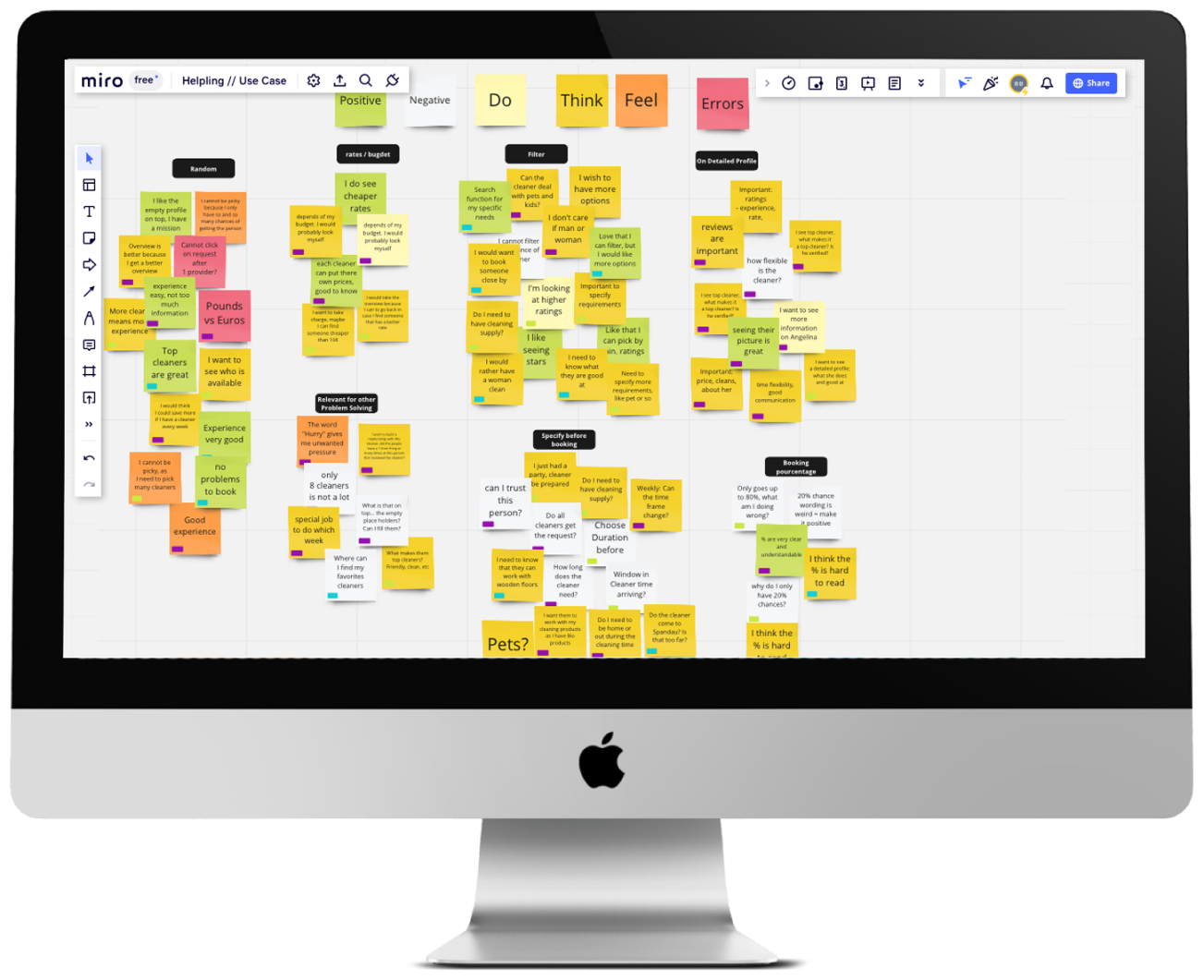
The prototype worked well, I had a 100% success rate in the task completion with a seamless user experience on booking a cleaner. It was clear that the users needed to book at least 4 aids to have a fortunate outcome, and there were no major mistakes. After the user testing and questioning was completed, I clustered all the relevant information into categories on Post-its. Those reflected if it was something positive, negative, an error or an observation (do, think, feel). The findings gave me many ideas on how to improve the product even further.
USER TESTING & ANALYSIS
I tested my prototype with 3 users. The participants had only 1 task to accomplish: Please book a cleaning aid for June 24th at 10am.
I also asked a few addition questions in order to have more insights:
What’s important for you when looking for a cleaner?
To search for a cleaner, would you rather swipe or have an overview? This question was intended to see if my swiping idea could be successful.
How was the experience of using the product to complete this task?
The prototype worked well, I had a 100% success rate in the task completion with a seamless user experience on booking a cleaner. It was clear that the users needed to book at least 4 aids to have a fortunate outcome, and there were no major mistakes. After the user testing and questioning was completed, I clustered all the relevant information into categories on Post-its. Those reflected if it was something positive, negative, an error or an observation (do, think, feel). The findings gave me many ideas on how to improve the product even further.
LEARNINGS & NEXT STEPS
I am grateful for this opportunity, which, like all projects, was incredibly educational and valuable. Although I did not get the job at Helpling, I received positive feedback on my work, allowing me to grow and learn. I had faith in my process and was proud of the outcome. Despite the tight timeline of four days for this project, it demonstrates that with hard work, dedication, and passion, anything is possible.
I learned to always ask follow-up questions and never make assumptions. During this project, I focused primarily on the UX process and neglected the UI, which was a mistake as the UI was equally important for the evaluation. Due to being ill during the project, I initially didn’t plan on conducting user testing, but I changed my mind and pushed through to test my prototype. This turned out to be a great decision, as the prototype worked exceptionally well, and I achieved a 100% success rate in completing the task of booking a cleaner. The user experience was seamless, and all my features were well-received.
The findings from the user testing have given me many ideas for further improving the product. My next steps include working on the “top cleaner” feature, making it more clear from the definition, adding a “I have a pet” checkbox in the filter, compressing the first part of the booking process and also exploring the partner side of the app, specifically for the cleaners.
LEARNINGS & NEXT STEPS
I am grateful for this opportunity, which, like all projects, was incredibly educational and valuable. Although I did not get the job at Helpling, I received positive feedback on my work, allowing me to grow and learn. I had faith in my process and was proud of the outcome. Despite the tight timeline of four days for this project, it demonstrates that with hard work, dedication, and passion, anything is possible.
I learned to always ask follow-up questions and never make assumptions. During this project, I focused primarily on the UX process and neglected the UI, which was a mistake as the UI was equally important for the evaluation. Due to being ill during the project, I initially didn’t plan on conducting user testing, but I changed my mind and pushed through to test my prototype. This turned out to be a great decision, as the prototype worked exceptionally well, and I achieved a 100% success rate in completing the task of booking a cleaner. The user experience was seamless, and all my features were well-received.
The findings from the user testing have given me many ideas for further improving the product. My next steps include working on the “top cleaner” feature, making it more clear from the definition, adding a “I have a pet” checkbox in the filter, compressing the first part of the booking process and also exploring the partner side of the app, specifically for the cleaners.
THANK YOU FOR TAKING THE TIME TO READ MY CASE STUDY!